


Should I Sell My RSUs When They Vest or Hold Them?

Summary
For most professionals earning company stock, selling Restricted Stock Units immediately upon vesting is a prudent strategy. RSUs are taxed as ordinary income based on the fair market value that day, the moment they vest. Holding them provides no inherent tax advantage outside of speculating that they'll go up in value. Selling immediately allows you to lock in the value and diversify your portfolio away from your employer. This approach also helps avoid the hidden tax drag of short-term capital gains caused by trading blackout periods. Diversification does not guarantee a profit or protect against loss, but it manages concentration risk.
The Golden Handcuffs Hangover
Abby watched her newly vested RSUs sit in her brokerage account. She worked as a senior marketer at a tech firm. Driven by loyalty to her company and a fear of missing out on future growth, she held onto every share. Then the stock took a massive hit following a missed earnings call. She realized her salary, her annual bonus, and her life savings were all tied to the same sinking ship.

Emotional attachment to employer stock often clouds objective financial decision-making. You spend forty hours a week building a product. You naturally want to believe in the financial upside of that hard work. Deciding what to do with vested RSUs is a foundational step in managing equity compensation, as this choice directly impacts concentration risk and long term wealth accumulation.
And don't be fooled: doing nothing is still an active investment decision. Choosing to hold an RSU is the exact financial equivalent of taking a cash bonus and using it to buy your company stock on the open market. Most people would never take a large cash bonus and pour every dollar into a single stock. Yet people do this with their equity compensation every vesting cycle. It's imperative to separate your emotional connection to your employer from your wealth-building strategy.
How Are RSUs Taxed When They Vest?
A common misconception exists regarding RSUs: people assume holding restricted stock units offers a tax shield. This assumption is incorrect. Upon vesting, the IRS treats the full value of those shares as ordinary income. Meaning your cost basis in the stock, which determines future tax impact, is the same as it would be if you bought those shares on the open market with cash. The fair market value of the stock on the vesting date determines your tax liability.

You owe taxes immediately. Companies handle this by withholding a portion of your shares. They withhold at a supplemental federal rate of 22 percent for amounts under one million dollars. State and local taxes also apply. The remaining shares land in your brokerage account, which we'll call 'net shares'.
You've already paid income tax on the value of those net shares, so holding the stock does not defer this initial tax. And now you face a critical decision the moment those shares enter your account. Selling the net shares immediately means your cost basis equals the sale price (or usually pretty close). You'll owe minimal capital gains tax in this scenario (often approaching $0).

Under-withholding presents a massive problem for high earners. Many professionals fall into Federal tax brackets well above 22 percent. The company withholding falls short of your actual tax liability (since the company isn't in the business of finding out all of its employees' personal financial situations). This creates a dangerous scenario come tax season. You might owe a massive tax bill in April. And selling shares provides the liquidity needed to cover this extra tax burden. Deciding to hold the shares leaves you exposed to market fluctuations while still owing the IRS, and the stock price could drop before you pay your tax bill.
Does Holding Vested RSUs Create Concentration Risk?
Yes. Holding vested RSUs often accumulates a massive position in a single company over time. Tying your human capital and your financial capital to the same entity creates extreme vulnerability. Your human capital is your ability to earn a salary and your financial capital is your investment portfolio.

An economic downturn hitting your company's sector impacts both components simultaneously.
Your company might announce layoffs.
The stock price will likely drop at the same time.
You could lose your job and watch your net worth plummet in the same week.
Diversifying your investments protects you against this compounded disaster.
A good rule of thumb is to keep no more than 25 to 30 percent of your net worth in a single stock as a guideline to manage risk. Some plans call for an even lower threshold depending on individual goals.
However, diversifying isn't all upside. Selling RSUs removes the opportunity to participate in future stock price appreciation. This is the trade-off for safety. You may miss out on potential massive gains if the company becomes the next giant. But you also avoid catastrophic losses if the company falters (this happens far more often than people publicize). Building long-term wealth requires managing the downside just as much as chasing the upside.
How Do Trading Blackout Periods Create a Hidden Tax Drag?
Trading blackout periods often force you to hold shares for days or weeks after they vest. Companies restrict trading to prevent insider trading violations. Meaning you might vest on a Tuesday, and the trading window remains closed for another three weeks (i.e., you cannot trade the shares).
The stock price moves during this restricted window (as it does every day). The stock might rise five dollars a share before the window opens, and if you sell the shares the moment you're allowed, that five-dollar gain is taxed as a short-term capital gain. This exact mechanic is the primary reason why people think holding RSUs for a year gives them a tax benefit, but in the grand scheme of things, it's rather small unless the stock moves up in price significantly.

These small gains add up. And if you experience this cycle four times a year, each vest generates short-term capital gains that can become significant. This creates a persistent reduction in your wealth accumulation over time.
This hidden tax drag eats into your compound growth. You pay ordinary income tax on the vest, and you then pay ordinary income rates again on any post vest bump. Taking control of your equity requires neutralizing this friction.
Should I Use Direct Indexing to Offset My RSU Taxes?
High tax bracket investors with recurring short-term equity gains need tools to neutralize tax drag. Direct indexing is an effective strategy for this specific problem. Direct indexing involves owning the individual stocks of an index rather than buying a single mutual fund.

Owning hundreds of individual stocks allows software to harvest small losses daily. While the overall market might be up for the year, many stocks within the index will still experience temporary drops. The software tools used in direct indexing strategies automatically sell the losing positions to capture the loss. It replaces the sold stock with a similar company to maintain the target asset allocation. We call this systematic tax loss harvesting.

These harvested short-term losses become a valuable asset. You use these losses dollar for dollar to offset the frustrating short-term capital gains generated when selling RSUs out of blackout periods. This process generates what we call "tax alpha".
**Direct indexing involves investment risk. All investments can lose value, including the principal amount invested. Customizing an index can lead to tracking error. Your portfolio might underperform the benchmark index due to these customizations. Tax loss harvesting requires careful navigation of wash sale rules. Tax laws change frequently. You should consult a tax professional before implementing complex strategies.
Key Takeaways
RSUs are taxed as ordinary income at vest. This removes any tax advantage to holding them longer.
Selling immediately minimizes short-term capital gains. This action also protects against concentration risk.
Trading blackout periods often force delayed sales. This delay often results in short-term capital gains taxed at high ordinary income rates.
Direct indexing and systematic tax loss harvesting can neutralize tax friction. These tools are designed for investors dealing with recurring RSU sales.
Diversification does not guarantee a profit. You must balance the risk of a single stock against the potential for future gains.
FAQs
What happens if my RSUs vest and the stock price drops before the trading window opens?
You experience a short-term capital loss if you sell the shares at a lower price than the vested fair market value. You can use this loss to offset other capital gains in your portfolio. You can use up to three thousand dollars of excess losses to offset ordinary income. The remaining losses carry forward to future tax years and the initial ordinary income tax on the vest remains unchanged.
How does the wash sale rule impact my monthly RSU vests?
The wash sale rule prevents you from claiming a tax loss if you buy a substantially identical security within thirty days before or after the sale. Monthly vesting complicates this process.
If your company grants you new shares every thirty days, selling older shares at a loss triggers a wash sale because the new vest counts as a replacement purchase. You must work with an advisor to time your sales and avoid disallowing your tax losses.
What is the difference between single-trigger and double-trigger RSUs at a private company?
Single-trigger RSUs typically vest based solely on a time requirement. Double-trigger RSUs require two events to occur before vesting.
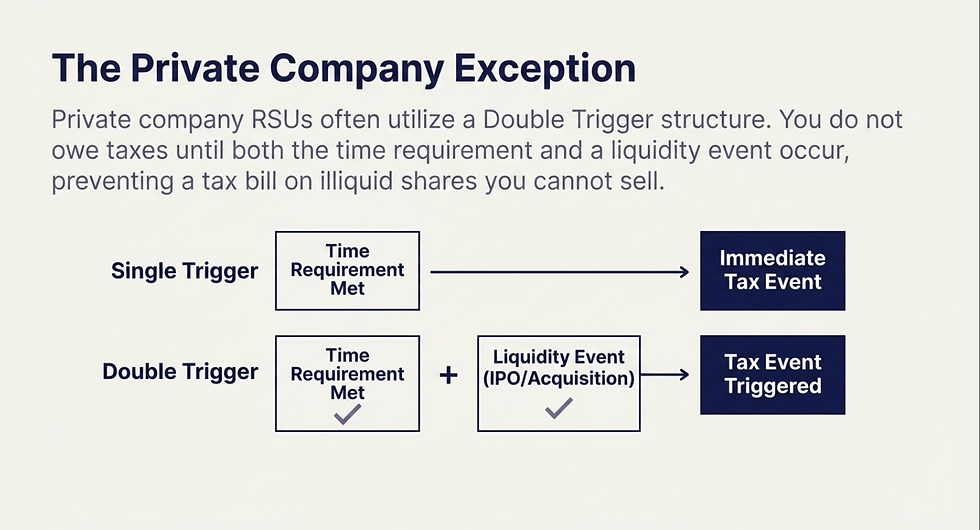
You must meet the time requirement first. A liquidity event, like an IPO or acquisition, must also happen. You do not owe taxes on double-trigger RSUs until both conditions are met. This structure prevents employees from owing taxes on private shares they cannot sell.
Your Next Steps
Review your vesting schedule. Map out your upcoming vest dates and cross-reference them with your company trading windows.
Evaluate your concentration. Calculate what percentage of your liquid net worth is tied up in your employer stock.
Automate your sales. Set up an automatic sell to cover or sell all elections for future vests if your plan allows it. This removes emotion from the process.
Analyze your tax drag. Look at your previous tax forms to see how much you paid in short-term capital gains taxes due to delayed RSU sales.
Taking Control of Your Equity
Managing equity compensation requires intention. Doing nothing leaves your financial future vulnerable to the volatility of a single company. Choosing to hold an RSU is the exact financial decision as taking a cash bonus and using it to buy your company stock. You must build a strategy that protects your human capital and grows your financial capital.
Tired of seeing short-term gains and trading blackouts eat into your equity comp? Let's talk about building a plan designed for tax efficiency. Schedule an introductory call today to learn more about our approach and determine if our services are a good fit for you.
To learn more about how we partner with clients, click here to view our services.
This blog is for educational purposes only and should not be taken as individual advice
Simplify Wealth Planning
Fast-Tracking Work Optional For Employees Earning Company Stock | Turn Your Stock Comp Into Wealth, Cut Taxes & Live Life Your Way | Flat Fees Starting at $10,000
Marcel Miu, CFA and CFP®, is the Founder and Lead Wealth Planner at Simplify Wealth Planning. Simplify Wealth Planning is dedicated to helping employees earning company stock master their money and achieve their financial goals.
Disclosures
Simplify Wealth Planning, LLC (“SWP”) is a registered investment adviser in Texas and in other jurisdictions where exempt; registration does not imply a certain level of skill or training.
If this blog refers to any client scenario, case study, projection, or other illustrative figure, such examples are hypothetical and based on composite client situations. Results are for informational purposes only, are not guarantees of future outcomes, and rely on assumptions specific to the scenario (e.g., age, time horizon, tax rate, portfolio allocation). Full methodology, risks, and limitations are available upon request.
Past performance is not indicative of future results. This message should not be construed as individualized investment, tax, or legal advice, and all information is provided “as-is,” without warranty.
The material and discussions are for informational purposes only. These do not constitute investment advice and are not intended as an endorsement for any specific investment.
The information presented in this blog is the opinion of Simplify Wealth Planning and does not reflect the view of any other person or entity. The information provided is believed to be from reliable sources, but no liability is accepted for any inaccuracies.
We recommend consulting with your independent legal, tax, and financial advisors before making any decisions based on the information in this blog or any of the resources we provide herein (models, etc.).


